


If you look at your smile and notice uneven edges, small teeth, discoloration, or old bonding that no longer looks natural — you're not alone.
Many patients tell us:
- "My teeth look too short."
- "My smile looks narrow."
- "My bonding keeps chipping."
- "I want a brighter, straighter smile without braces."
At Witkowski Dental in Mokena, IL, porcelain veneers offer a conservative, long-lasting way to reshape, brighten, and harmonize your smile.
What Are Porcelain Veneers?
Porcelain veneers are thin, custom-made ceramic restorations bonded to the front surface of teeth to improve:
- Tooth length
- Width and proportions
- Color and brightness
- Alignment appearance
- Symmetry
- Incisal edge shape
Veneers allow you to change the shape, size, and shade of your teeth — often without orthodontics.
They are stain-resistant, durable, and designed to mimic the translucency and texture of natural enamel.
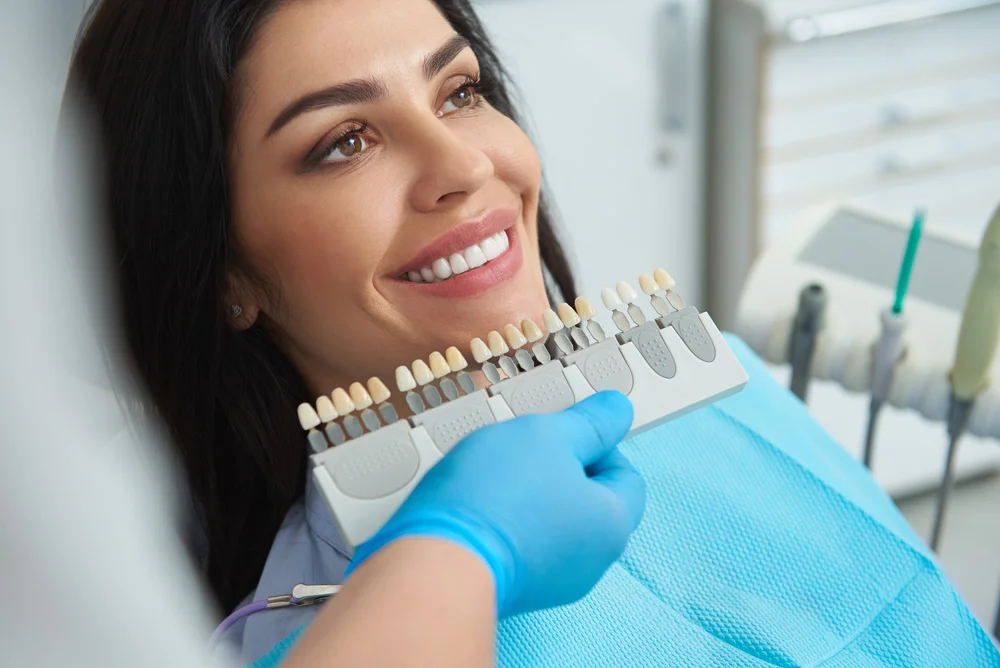
What Can Veneers Correct?
Veneers are ideal for patients who want to address:
- Short or uneven teeth
- Worn incisal edges
- Mild spacing
- Tapered or narrow smile appearance
- Discolored or stained teeth
- Failing composite bonding
- Minor alignment irregularities
If your gums are healthy and your bite is stable, veneers may be an excellent option.
The Veneer Process at Witkowski Dental
1. Smile Design & Planning
Every veneer case begins with detailed planning.
We perform:
- Complete exam
- Digital imaging
- Diagnostic wax-up
- Digital smile design
This allows you to visualize proposed changes in tooth length, width, and alignment before treatment begins.
2. Conservative Preparation
Minimal enamel is reshaped to create space for the veneer while preserving natural tooth structure.
Digital scans are taken to ensure precision and fit.
3. Provisional Veneers
Temporary restorations reflect the planned final design and allow you to:
- Evaluate new length and shape
- Assess incisal edge alignment
- Provide feedback
- Confirm comfort and speech
4. Final Bonding
Custom porcelain veneers are bonded using adhesive protocol for long-term strength.
Special attention is given to:
- Line angles
- Shade blending
- Edge design
- Symmetry
- Occlusion
The result is a natural, balanced smile designed specifically for you.
Veneer Case Study #1: Refining Tooth Length and Smile Symmetry (50-Year-Old Female)
A 50-year-old female presented with cosmetic concerns regarding her upper front teeth, specifically teeth #7–10. While her teeth were healthy, she felt her smile lacked harmony and balance.
Her Primary Concerns
She explained that:
- Her lateral incisors appeared noticeably shorter than her central incisors
- The distal edges of her front teeth angled inward toward the midline
- Her smile looked slightly tapered rather than straight and broad
She wanted her lateral incisors to match the length of her central incisors and requested a straighter, more uniform incisal edge line.
Clinical Evaluation
Examination revealed:
- Healthy periodontal tissues
- Stable occlusion and phonetics
- Existing restorations in acceptable condition
- Slight length discrepancy between centrals and laterals
- Mild convergence of distal incisal edges creating a narrowed smile appearance
Although subtle, these differences significantly impacted the perceived symmetry of her smile.
Smile Design & Treatment Planning
A complete digital smile design and diagnostic wax-up were completed to:
- Lengthen the lateral incisors to match the centrals
- Correct distal line angles
- Establish a straight, harmonious incisal edge line
- Create a broader, more youthful appearance
The patient reviewed and approved the proposed design before treatment began.
Clinical Procedure
Minimal-preparation porcelain veneers were performed on teeth #7–10.
Conservative enamel reshaping allowed for ideal contours while preserving tooth structure. Digital scans were taken, and provisional restorations were fabricated to reflect the proposed final design.
During the provisional phase, the patient confirmed:
- Satisfaction with the new tooth length
- Approval of the straightened incisal edge
- Improved smile symmetry
At the final appointment, porcelain veneers were tried in to verify:
- Fit
- Shade
- Proportions
- Edge alignment
The veneers were then bonded using adhesive resin cement under isolation protocol.
Final Outcome
The completed restorations achieved:
- Equalized lateral and central incisor length
- Straighter, balanced incisal edge line
- Corrected distal line angles
- Broader, more youthful smile
The transformation was natural and refined — enhancing her features without appearing artificial.
Veneer Case Study #2: Brightening and Widening a Young Smile (23-Year-Old Female)
A 23-year-old female presented with concerns that her teeth appeared small, narrow, and lacked brightness. She was also dissatisfied with composite bonding placed several years earlier.
Her Concerns
She reported:
- Teeth that appeared shorter and narrower than ideal
- A smile that lacked fullness
- Discolored, chipped composite bonding
- Uneven shade between natural enamel and older restorations
She wanted a long-term cosmetic solution rather than repeatedly repairing bonding.
Clinical Findings
Examination revealed:
- Multiple anterior teeth with worn, stained composite restorations
- Marginal breakdown and leakage around bonding
- Shorter and narrower tooth proportions
- Darker, uneven shade
- Healthy periodontal tissues
- Stable occlusion
The existing bonding not only affected esthetics but also long-term durability.
Treatment Goals
The patient desired to:
- Improve overall brightness and shade
- Lengthen and broaden tooth proportions
- Create a fuller smile appearance
- Replace failing composite restorations
- Achieve a natural, long-lasting result
Treatment Plan
A combined approach was recommended:
- Porcelain veneers on select maxillary anterior teeth
- Cosmetic composite bonding on adjacent teeth
This conservative plan allowed for:
- Correction of color discrepancies
- Improved symmetry
- Increased smile width
- Preservation of natural tooth structure
A diagnostic wax-up and digital smile design were completed to preview increased width, enhanced incisal edge length, and a lighter yet natural shade.
The patient approved the proposed smile design.
Clinical Procedure
Failing composite restorations were removed. Conservative veneer preparations were completed, and digital scans were taken.
Provisional restorations were fabricated to reflect:
- Increased tooth width
- Improved length proportions
- Balanced incisal edges
- Enhanced brightness
After evaluating phonetics, contour, and esthetics, final porcelain veneers were fabricated and bonded.
Cosmetic bonding was completed on adjacent teeth to seamlessly blend with the veneers and maximize smile width and harmony.
Final Outcome
The completed treatment achieved:
- Brighter, uniform shade
- Increased smile width
- Improved tooth proportions
- Replacement of compromised bonding
- Long-term durability
The patient reported increased confidence and satisfaction with her new smile, noting it looked natural — just enhanced.
Veneers vs. Bonding: What's the Difference?
Composite bonding:
- Lower initial cost
- May stain or chip over time
- Often requires maintenance or replacement
Porcelain veneers:
- More durable
- Stain resistant
- Longer lasting
- Superior esthetics and translucency
We will review both options honestly during your consultation so you can make an informed decision.
Frequently Asked Questions About Veneers
Why Patients in Mokena Choose Witkowski Dental for Veneers
Cosmetic dentistry is not just about brightness — it's about proportion, symmetry, line angles, and facial harmony.
At Witkowski Dental, we prioritize:
- Conservative preparation
- Detailed smile design
- Functional occlusion
- Natural esthetics
- Long-term stability
A beautiful smile should look like you — just refined.